Elevate Your Ecommerce: Mastering Ecommerce and Zoho CRM Integration
Modern eCommerce businesses rely heavily on efficient customer management, automation, and data-driven decision-making. As online stores grow, managing customer details, purchase history, and communication manually becomes increasingly complex. Many businesses struggle with scattered data, inefficient workflows, and limited visibility into customer behavior.
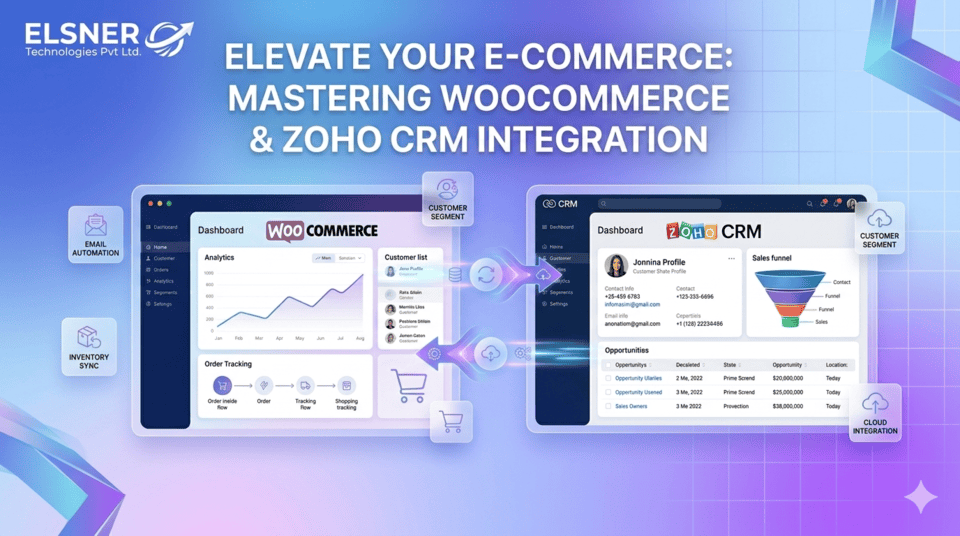
Implementing zoho crm woocommerce integration allows businesses to synchronize WooCommerce store data with Zoho CRM, creating a centralized system that automatically tracks customers, orders, and sales activities. This integration enables businesses to improve customer relationship management, streamline sales pipeline tracking, and gain deeper insights into purchasing behavior. With connected systems, businesses can automate workflows, improve customer data management, and build stronger relationships that drive long-term eCommerce growth.
2. The Growing Need for CRM in eCommerce Businesses
Customer expectations in online shopping are evolving rapidly. Today’s buyers expect personalized experiences, fast responses, and seamless interactions across multiple channels. Without proper systems in place, managing customer interactions can become overwhelming for store owners and sales teams.
By implementing woocommerce zoho crm integration, businesses can automatically sync customer information and order history between WooCommerce and Zoho CRM. This helps maintain accurate customer profiles while enabling sales and marketing teams to access real-time data for better decision-making. With improved customer lifecycle management, businesses can deliver targeted marketing campaigns, improve engagement, and enhance customer retention.
3. How Zoho WooCommerce integration Works
Understanding how integrations work helps businesses unlock their full potential. When WooCommerce is connected with Zoho systems, customer information, order details, and transaction data are automatically transferred between platforms.
Through Zoho WooCommerce integration, store owners can ensure that every order placed on their website is instantly recorded within the CRM system. This synchronization eliminates the need for manual data entry while ensuring that sales teams always have access to the latest information. By automating data synchronization and workflow management, businesses can improve operational efficiency and maintain accurate records across their systems.
4. Centralized Customer Data Management with WooCommerce Zoho CRM
One of the biggest challenges in eCommerce operations is managing customer data across multiple platforms. Without a unified database, businesses may struggle to gain clear insights into customer behavior and purchasing patterns.
Using Woocommerce Zoho CRM, businesses can create centralized customer profiles that store detailed information such as purchase history, communication records, and product preferences. This allows businesses to analyze customer behavior more effectively and deliver personalized experiences that improve customer satisfaction.
5. Automated Lead and Order Tracking through WooCommerce Zoho integration
Automation plays a crucial role in improving operational efficiency for online stores. When businesses rely on manual processes for lead tracking and order management, it increases the risk of delays and human errors.
With WooCommerce Zoho integration, customer orders can automatically generate leads within the CRM system. This allows sales teams to track customer activities, manage leads efficiently, and monitor sales opportunities within the pipeline. Automated lead management ensures that potential customers are followed up with promptly, improving conversion rates and boosting overall sales performance.
6. Improved Sales Insights and Reporting with WooCommerce Zoho integration
Data analytics plays a vital role in helping businesses understand what drives sales and customer engagement. Without integrated reporting tools, store owners may find it difficult to identify top-performing products or analyze customer purchasing trends.
By implementing WooCommerce Zoho integration, businesses can generate detailed reports that highlight key metrics such as product performance, customer lifetime value, and revenue trends. These insights help businesses refine their marketing strategies, optimize product offerings, and identify growth opportunities.
7. Enhanced Customer Engagement with WooCommerce Zoho integration
Building strong relationships with customers requires consistent communication and personalized marketing efforts. Businesses that understand customer behavior can create more relevant campaigns that resonate with their audience.
Through WooCommerce Zoho integration, businesses can automate personalized communication such as promotional emails, product recommendations, and follow-up messages. This helps create a more engaging customer journey while encouraging repeat purchases and long-term loyalty.
8. Efficient Inventory and Order Management with WooCommerce integration with Zoho Inventory
Managing inventory accurately is essential for delivering a smooth shopping experience. Inventory issues such as stock shortages or overselling can negatively impact customer satisfaction and business reputation.
Using WooCommerce integration with Zoho Inventory, businesses can synchronize stock levels between their store and inventory management systems. This ensures accurate product availability, improves order fulfillment speed, and allows businesses to manage inventory across multiple sales channels efficiently.
9. Reduced Manual Work and Operational Errors
Manual data entry and disconnected systems often lead to errors, duplicated records, and inefficiencies in business operations. Automation helps eliminate these challenges by ensuring that data flows seamlessly between platforms.
Integrated systems reduce the need for repetitive administrative tasks and allow teams to focus on strategic activities such as customer engagement and business growth.
10. Scalability Benefits for Growing Online Stores
As online stores expand, they require systems that can handle increasing customer data, higher order volumes, and complex business operations. Integrated platforms provide the flexibility and scalability needed to support long-term growth.
Businesses that adopt integrated solutions can easily adapt to market changes, expand product catalogs, and manage growing customer bases without disrupting their operations.
11. Conclusion
Integrating WooCommerce with Zoho CRM provides a powerful solution for businesses looking to improve efficiency, automate workflows, and gain better visibility into customer interactions. By connecting these systems, businesses can streamline operations while improving customer engagement and sales performance.
With the right integration strategy, online stores can create a unified ecosystem that connects customer data, sales processes, and inventory management. This enables businesses to deliver better shopping experiences while positioning themselves for long-term success using modern WooCommerce & WordPress plugins that support advanced eCommerce functionality.